Understanding & Processing Emotions
Emotions are a natural part of being human. They can give us information about what is happening within us, what matters to us, and what we might need.
Some emotions are comfortable and easy to welcome, while others — such as sadness, anger, fear, shame or disappointment — can feel much harder to sit with. You may have learned to push these feelings away, keep busy, distract yourself or try to think your way out of them.
Sometimes emotions can also feel confusing. You might know that something doesn't feel right but find it difficult to identify exactly what you are feeling or why.
Processing an emotion doesn't mean getting stuck in it or letting it take over. It means giving yourself enough space to notice the feeling, understand what it may be communicating, and allow it to move through rather than immediately pushing it away.
Over time, learning to notice and understand your emotions can help you respond to yourself with greater awareness and choice.
What Are Emotions Trying to Tell Us?
Emotions can be thought of as messengers. They often give us information about what is happening for us, what matters to us, or what we might need.
For example:
Sadness might tell us that we have lost something or someone important to us.
Anger might let us know that a boundary has been crossed, something feels unfair, or something important to us needs attention.
Fear or anxiety might be telling us that something feels uncertain, unsafe or outside our control.
Guilt might encourage us to reflect on something we have done and consider whether we want to repair or do something differently.
Loneliness might point towards a need for connection, belonging or closeness.
Emotions don't always give us the whole story, and they don't necessarily tell us what we should do. But they can give us useful information.
Instead of asking, “How do I get rid of this feeling?”, you might gently ask:
“What might this feeling be trying to tell me?”
What Does It Mean to Process an Emotion?
Processing an emotion means allowing yourself to notice and experience what you are feeling, rather than immediately trying to push it away, fix it or distract yourself from it.
This doesn't mean becoming overwhelmed by the emotion or staying in it for a long time. Sometimes it might only mean giving yourself a few moments to acknowledge what is there.
You might notice:
Where do I feel this in my body?
Perhaps there is tightness in your chest, a heavy feeling, a knot in your stomach, warmth, tension or an urge to move.
What emotion might be here?
See if you can gently name it — sadness, anger, fear, disappointment, loneliness, hurt or something else.
What might this emotion be connected to?
You don't have to analyse it deeply. Simply notice what comes to mind.
What might I need right now?
Perhaps comfort, reassurance, space, connection, rest, understanding or simply permission to feel what you're feeling.
Sometimes the most helpful thing you can do is to allow the feeling to be there without needing to change it straight away.
Emotions often shift when they have been noticed, acknowledged and given some space.
A Simple Way to Process an Emotion
When an emotion shows up, you don't always need to understand it straight away. Sometimes it can help to slow things down and gently work through a few simple steps.
1. PAUSE — Give yourself a moment
If you can, pause rather than immediately reacting, fixing or distracting yourself.
2. NOTICE — What is happening in my body?
Notice any sensations — tightness, heaviness, warmth, butterflies, tension, tears, restlessness or perhaps numbness.
3. NAME — What am I feeling?
See if you can put a name to the emotion. You don't have to get it exactly right. “I think I'm feeling hurt” is enough.
4. ALLOW — Can I let this feeling be here for a moment?
Rather than trying to make the emotion disappear, see if you can give it a little space. You might gently remind yourself, “It's okay for me to feel this.”
5. LISTEN — What might this feeling be telling me?
Is something important to you? Has something hurt? Has a boundary been crossed? Are you missing something or someone?
6. NEED — What might I need right now?
Perhaps comfort, space, reassurance, connection, rest, understanding — or simply some time.
You don't have to work through every step perfectly. The idea is to slow the moment down enough to listen to what your emotion may be communicating, without letting the emotion decide what you do next.
Notice it → Name it → Allow it → Listen to it → Consider what you need.
Finding the Words
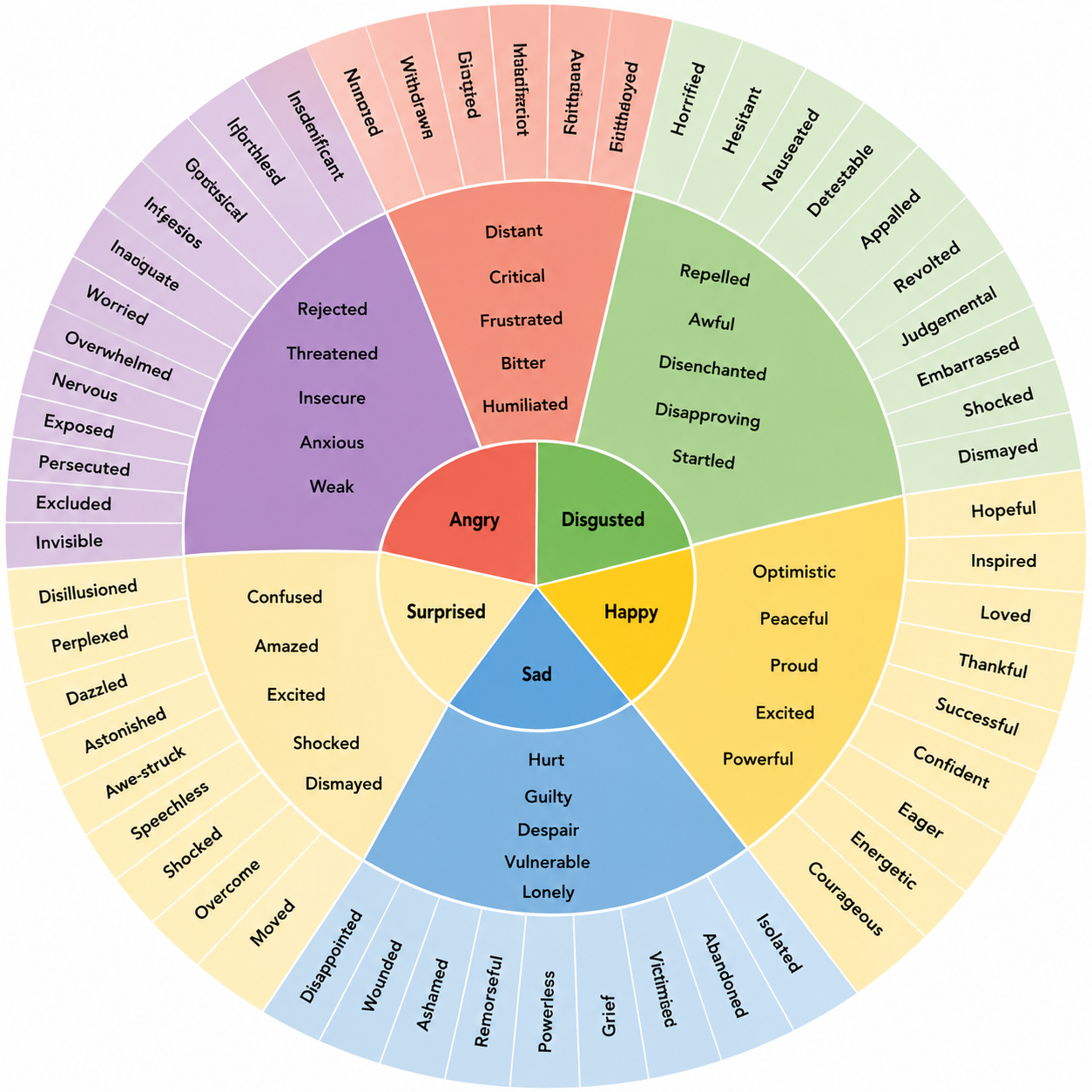
Sometimes it can be difficult to know exactly what you're feeling. A Feelings Wheel can help you find words that more closely describe your experience.
Start near the centre with the emotion that feels closest, then move outward to see if another word fits more clearly.
There is no right or wrong answer — simply notice which word feels most like your experience.
When Emotions Feel Overwhelming
Sometimes an emotion can feel too strong to sit with or process in the moment. You might feel flooded, panicked, very angry, unable to think clearly, or notice that you want to shut down or escape from what you're feeling.
When this happens, you don't need to push yourself to explore the emotion more deeply.
Instead, it may be more helpful to focus first on helping your nervous system feel safe and settled. This might mean grounding yourself, slowing your breathing, moving your body, stepping outside, connecting with someone you trust, or simply giving yourself some space.
As your nervous system begins to settle and you move back towards your Window of Tolerance, you may find it easier to come back to the emotion with curiosity.
You don't have to process everything at once. Sometimes regulation comes first, and understanding can come later.
Explore More
If you’d like to continue exploring your emotions and how your nervous system responds, these resources may also be helpful:
Understanding Triggers
Explore what can sit underneath a strong reaction and how triggers can connect with emotions and needs.
Window of Tolerance
Learn to recognise when you are feeling regulated, highly activated or moving towards shutdown.
Supporting Your Nervous System
Discover practical ways to help your nervous system settle when emotions feel overwhelming.
Grounding Tools
Simple strategies to help bring your attention back to the present moment and feel more settled.