Sudden Goodbyes and Slow Goodbyes: Different Experiences of Grief
There are many ways we experience the loss of someone we love. Sometimes death comes suddenly and unexpectedly. Other times, we watch someone we love gradually decline through illness or ageing.
Both experiences can bring deep grief, although the journey may look and feel quite different.
When goodbye comes suddenly
An unexpected death can leave us feeling shocked, overwhelmed and struggling to make sense of what has happened.
There may have been no opportunity to prepare, to say the things we wanted to say, or to share one final goodbye.
We might find ourselves replaying our last conversation or wishing we had known that an ordinary moment together would be our last.
When goodbye happens slowly
When someone we love is living with a serious or life-limiting illness, grief can begin long before they die. This is sometimes called anticipatory grief.
We may grieve the gradual changes in their health, independence, personality or the life we once shared.
There can be a mixture of hope, fear, sadness, exhaustion and uncertainty. Sometimes, when the person dies, we may also experience relief that their suffering has ended. This can be accompanied by guilt, even though relief and love can exist together.
Knowing that someone is dying does not necessarily make their death easier or mean we are prepared for life without them.
There is no easier way to say goodbye
People sometimes try to comfort us with words such as "At least you had time to prepare" or "At least they didn't suffer."
Although often well-intentioned, these words can unintentionally minimise our grief.
Every relationship is unique, and so is every experience of loss.
We don't need to compare our grief with someone else's or feel that we should be coping differently.
Sometimes what matters most is simply having someone alongside us who is willing to listen, acknowledge our loss and make space for whatever we are feeling.
There is no perfect goodbye, no right way to grieve, and no timetable for healing.
Grief, Loss & Life Changes
Grief can come with many different kinds of loss — the death of someone important, the end of a relationship, changes in health or work, changes within family, or a life that has turned out differently from what you expected.
There is no single way to experience grief, and there is no set timeline for how you should feel.
This resource area is being developed to offer gentle information, reflections and practical tools to help you understand grief, adjust to significant life changes, and find ways of living alongside loss at your own pace.
If you're navigating grief or loss, you don't have to find your way through it alone. Counselling can offer a compassionate space to share your story, explore your feelings and find your own way forward, at your own pace.
Grief Can Hold More Than One Feeling
Grief is rarely just sadness. It can bring a mixture of emotions that sometimes seem to contradict one another.
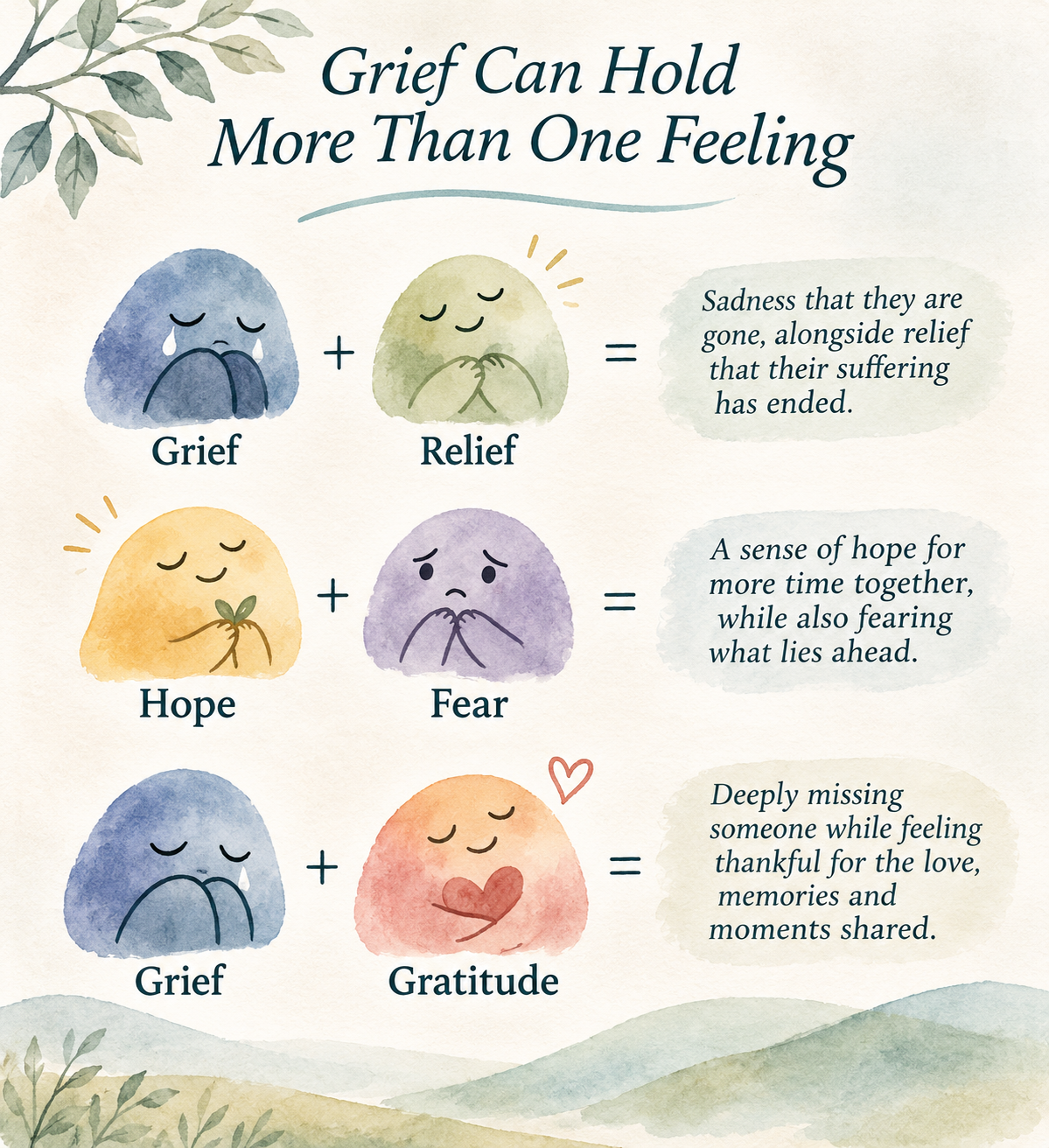
We might feel grief and relief when someone we love dies after a long illness — sadness that they are gone, alongside relief that their suffering has ended. Sometimes that relief brings feelings of guilt, leaving us wondering whether we should feel differently.
We may experience hope and fear at the same time, particularly when someone we love is seriously unwell. We can hope for more time together while also fearing what lies ahead.
And sometimes we feel grief and gratitude — deeply missing someone while feeling thankful for the love, memories and moments we shared.
These feelings can exist alongside one another. We don't have to choose between them, explain them away or judge ourselves for experiencing them.
Feeling relief doesn't mean we loved someone less. Feeling grateful doesn't mean we miss them any less. And feeling hopeful doesn't mean we're not afraid.
There is room for all these emotions in grief.
Growing Around Grief
We often hear that time heals or that grief becomes smaller as the years pass. But for many people, grief doesn't necessarily disappear or become less significant.
Instead, our lives may gradually grow around our grief.
The love, memories and sense of loss can remain, while we slowly make room for new experiences, relationships, moments of happiness and meaning.
One way of understanding this is through the Growing Around Grief model, associated with grief researcher Lois Tonkin.
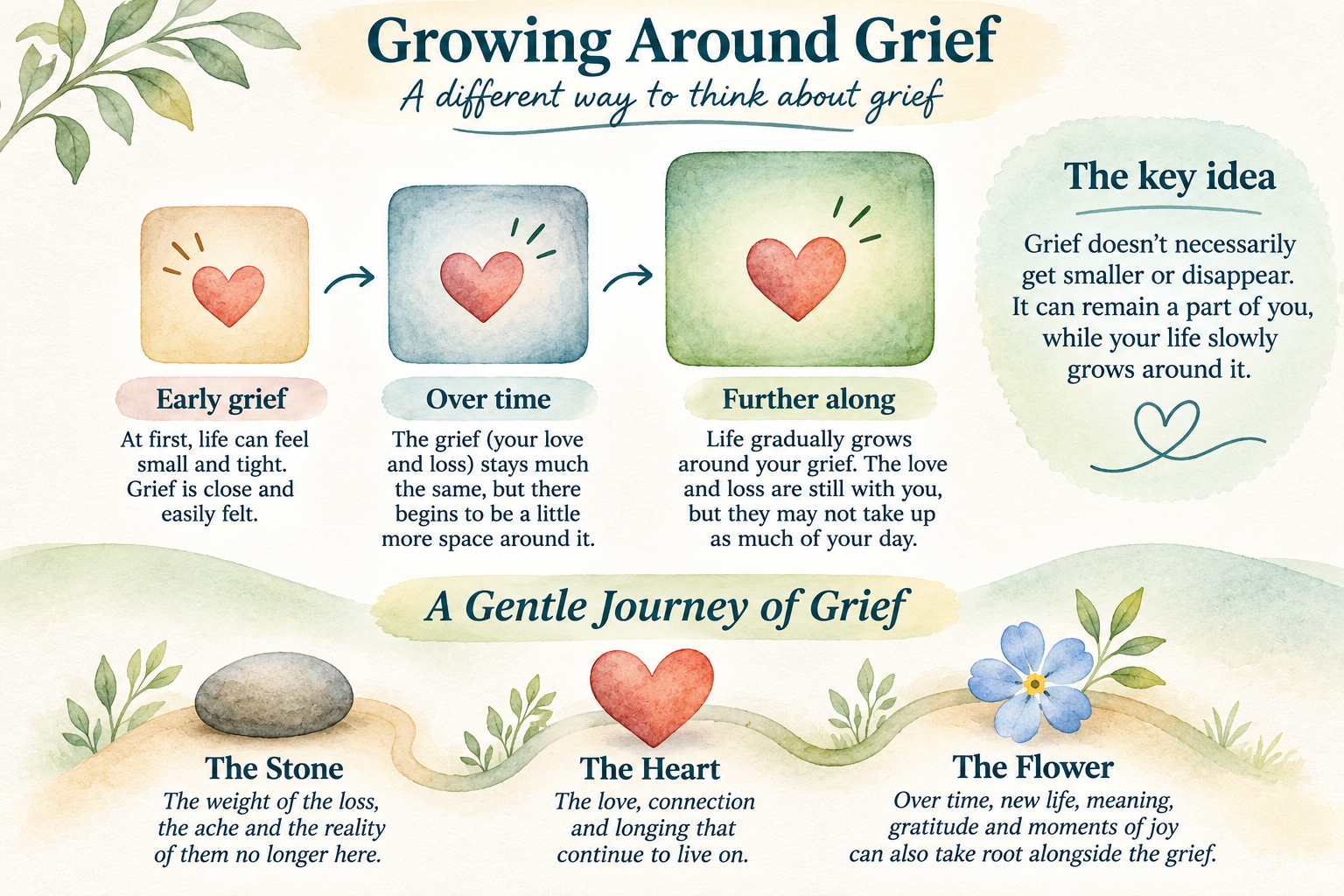
Imagine grief as a heart inside a small box. At first, the heart takes up much of the available space. As time passes, the heart doesn't necessarily become smaller, but the box around it gradually grows.
The grief is still there, but there may be more room for other parts of life.
We can also imagine grief as a gentle journey:
The Stone represents the weight of loss, the ache and the reality of someone no longer being here.
The Heart represents the love, connection and longing that continue even after someone has died.
The Flower represents the possibility of new meaning, gratitude, connection and moments of joy growing alongside our grief.
There may still be days when grief feels just as intense as it did in the beginning. A familiar song, a birthday, a smell or an unexpected memory can bring those feelings close again.
This doesn't mean we have gone backwards or that we aren't healing.
Grief is not a journey with a fixed destination. For some, it softens over time. For others, it remains deeply present. There is no single way that grief should unfold.
We don't have to stop missing someone to begin living fully again. There can be room for both grief and life.
If you're navigating grief or loss, you don't have to find your way through it alone. Counselling can offer a compassionate space to share your story, explore your feelings and find your own way forward, at your own pace.